The Night the Village Hall Became a Jukebox
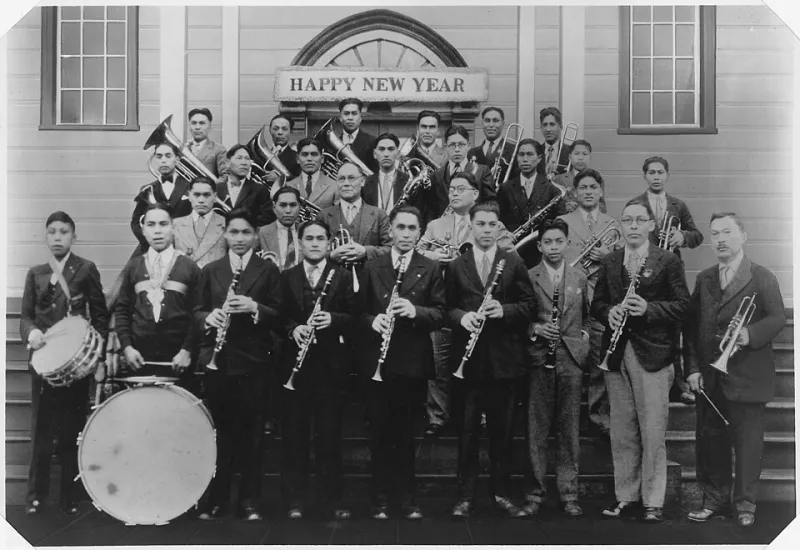
Photo: Unknown authorUnknown author or not provided, Public domain, via Wikimedia Commons
There is a moment, usually just after the raffle has been drawn and just before the tea urn gets its second wind, when someone at the back of the village hall decides to test the water. You can almost hear the thought forming: go on, ask them. Then comes the shout. It might be a title. It might be a tune. It might be a vague description involving a film, a advert and a cousin's wedding in 1998. Either way, the request line is officially open.
For a community brass band, this is both the best bit and the bit where you quietly check the exits. Manea Silver Band is not a jukebox. We are a group of people who rehearse on Wednesdays, argue gently about tempo, and occasionally arrive with the wrong music in the wrong folder. But we are also a village band, and a village band belongs to the village. If you have turned out on a wet Friday to hear us, the least we can do is try to play the thing you shouted.
It Usually Starts with a Shout
Requests rarely arrive in an orderly fashion. They tend to come from someone near the back who has had a good evening and has decided that the band should know about it. The first shout is often for something obvious — a march, a show tune, something with a tune you can hum on the way home. The second shout is usually a correction. The third is often from a different person entirely, and by then the band is looking at each other with the particular expression that means: who knows this one, and in what key?
At one Manea gig a few years back, a request for a well-known hymn came in while we were mid-way through a perfectly respectable arrangement of something else. We finished, nodded wisely, and then discovered that half the band knew the hymn in one key and half knew it in another. What followed was not so much a performance as a negotiation. The audience, to their credit, joined in anyway. By the last verse it had settled down into something close to harmony. That is village music in a nutshell: slightly wonky, entirely sincere, and better for the joining in.
The Anatomy of a Good Request
If you want to hear a favourite at a 2026 event, there are a few things that help. The first is a title. Even an approximate one is useful. 'That one from the advert' is less helpful than 'that one from the advert with the dog', though both are better than a tune whistled in the wrong key by a well-meaning uncle.
The second is timing. Catching a player during the interval is much more effective than shouting across the hall while the conductor is trying to count in a waltz. We are a friendly lot. Ask us at the tea table. Write it on the back of your raffle ticket. Hum a few bars if you must. We will do our best, and if we cannot, we will at least enjoy trying to work out what you meant.
The third is patience. A request is not a command. We have a programme to get through, a conductor with a plan, and a tuba player who needs to know what is happening at least four bars before it happens. If your tune does not appear tonight, it might appear next time. Several of our regulars have been requesting the same piece for years. We are starting to think they enjoy the chase.
Curveballs, Carols and the Archers Theme
Not every request is a curveball, but the curveballs are memorable. We have had requests for film themes, football chants, and one memorable evening when someone asked for the theme from The Archers. To be fair, it is a good tune. To be fairer, it is not in our pad. The player concerned smiled politely, said we would see what we could do, and then spent the next twenty minutes looking at the ceiling as if the answer might be written there.
Christmas gigs bring their own category of request. Carols are fair game, and we are always happy to oblige if we can. But there is a special kind of chaos that arrives when someone asks for a carol nobody has rehearsed since primary school. The audience knows it. The band half-knows it. The result is a sort of communal guess that occasionally lands on the right chord. Nobody has ever complained. In fact, those are often the moments people remember longest.
How to Get Your Tune Heard in 2026
So if you are coming to a Manea Silver Band event in 2026 and you have a tune in mind, here is the informal guide. Ask early if you can. Ask a player rather than the whole band. Have a title ready, or at least a decade and a genre. Be prepared for the answer to be 'not tonight, but maybe next time'. And if we do play it, do not be shy about singing along. We are not precious about it. A village hall is not the Royal Albert Hall, and thank goodness for that.
The request line is not a formal thing. There is no phone number, no email address, no queue. It is just the lovely, slightly chaotic business of a band and an audience working out what to play together. It is the bit where the gig stops being a performance and starts being a conversation. And in a village like Manea, that is exactly how it should be.
So go on. Shout it from the back. We will probably hear you. We might even know it.