The Rail by the Door: What Manea's Band Jackets Remember
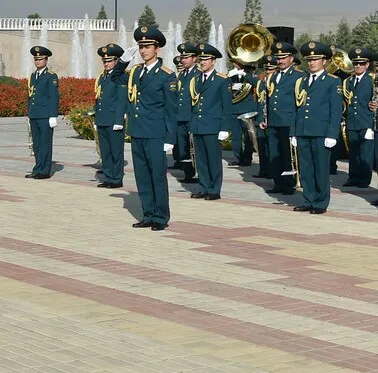
Photo: Presidential Press and Information Office, CC BY 4.0, via Wikimedia Commons
Walk into Manea Village Hall on a Wednesday night and you will see the usual: chairs in loose rows, music stands, a kettle doing its best. But before the first note, there is another ritual. Someone wheels out the uniform rail. It squeaks. It leans. It is not glamorous. And yet, for a few minutes, the room changes.
The rail is older than most of the players
The rail itself is a survivor. It has been repaired with cable ties, borrowed from a church hall, and returned late more than once. The jackets hanging on it are a different story. Some are older than the people wearing them. A few have been in the band longer than the current conductor. They are hand-me-downs in the proper sense: passed from player to player, altered at the sleeves, taken in at the waist, let out again when the Christmas raffle has been kind.
There is a jacket on that rail that has played something like 300 gigs. Nobody knows the exact number. It has been to fetes, weddings, remembrance services, care homes, a rainy park bandstand and at least one event where the marquee tried to leave. The seams have been stitched by three different people. The buttons are a mixed set. One pocket still has a name tag from a player who moved away years ago. It is not a museum piece. It is a working jacket, and it still goes out on a Saturday.
Buttons, badges and the small economy of keeping going
Manea Silver Band does not have a uniform budget that would make a tailor weep with joy. We have a uniform budget that makes a tailor weep, full stop. So the rail operates on a quiet economy of kindness. A missing button is replaced from a tin in the band cupboard. A torn lining is pinned and promised to a friend who sews. A jacket that no longer fits one player is offered to another before anyone thinks about buying new. The band's colours are not just black and silver; they are also the colour of a borrowed needle and thread.
Name tags are their own small archive. Some are sewn in, some are ironed on, some are held on with hope. When a player leaves, the tag often stays. Nobody is quite sure whether to remove it. It feels like erasing a little bit of the band's memory. So the jacket goes back on the rail with two names inside it, or three, and the next wearer adds their own. It is not tidy. It is honest.
The ceremony before the gig
Putting on the band's colours is not the same as putting on a coat. It is a small ceremony, even when it is rushed. In the winter, the jackets are cold. In the summer, they are warmer than anyone would like. But when the rail comes out and players start finding their size, the mood shifts. The chatter gets a little quieter. Someone checks a collar. Someone else does up a button that has been done up a thousand times. The conductor might say nothing at all. There is no drumroll. But everyone knows the gig is close.
For newer players, the jacket is a rite of passage. The first time you wear it, you feel like you have been let in on something. For older players, it is a familiar weight. It carries the shape of previous shoulders. You can feel the history in the slightly stretched cuff and the faint smell of old dry cleaning. It is not sentimental to say that. It is just true.
Why the rail matters
A band is a lot of things: rehearsals, scales, raffle tickets, lifts home, the search for a missing mute. But it is also a set of shared objects. The rail by the door is one of them. It reminds us that Manea Silver Band is not a company with a uniform supplier. It is a village band that keeps going because people look after what they have. The jackets are not perfect. Neither are we. But they are ours, and they have been to places we remember.
So next time you see the band at a fete or in the hall, look at the uniforms. Look at the buttons that do not quite match. Look at the name tags that have been added and left. That rail has played 300 gigs, give or take. It has a few more in it yet.